Saturday, January 07, 2006

Drinking and Divorce Among Geezers

Social Science & Medicine
Volume 61, Issue 11 , December 2005, Pages 2304-2316


Heavy alcohol use and marital dissolution in the USA

Jan Ostermann, Frank A. SloanCorresponding Author Contact Information, E-mail The Corresponding Author and Donald H. Taylor

Center for Health Policy, Law and Management, Duke University, Box 90253, Durham, NC 27708, USA

Available online 2 September 2005.

Using the first five waves of the US Health and Retirement Study, a nationally representative survey of middle-aged persons in the USA conducted between 1992 and 2000, we assessed the association between alcohol consumption and separation and divorce (combined as divorced in the analysis) for 4589 married couples during up to four repeated 2-yr follow-up periods. We found that drinking status was positively correlated between spouses. The correlations did not increase over the follow-up period. Discrepancies in alcohol consumption between spouses were more closely related to the probability of subsequent divorce than consumption levels per se. Couples with two abstainers and couples with two heavy drinkers had the lowest rates of divorce. Couples with one heavy drinker were most likely to divorce. Controlling for current consumption levels, a history of problem drinking by either spouse was not significantly associated with an increased probability of divorce. Our findings on alcohol use and marital dissolution were highly robust in alternative specifications.

>>>>>>>>>>>>>>>>>>>>>>>>>

[The other Francis Bacon]


BrooklynDodger Comments:
The Dodger hopes readers will not read too much into a continuing interest in health effects of alcohol consumption, or their absence. In this study, it appears that heavy drinking only causes divorce if your spouse doesn't drink.

The abstract leaves out the most important observations because of focus on the analytical aims. The HRS study sample consisted of persons aged 51–61 in 1992 and their spouses, if married. Only 189 or 4% of the sample divorced during the observation period, with the proportion falling to 0.5% during the last 2 year period. The Dodger guesses that couples making it to 51 and still married figure they have to live with whomever they have, and the longer they stay together, the better chance of finishing out that way.

Overall, 40% were abstainers, with a higher percentage of abstainers among women, and persons of both genders not divorced. Few women copped to heavy drinking, but 2.5% of the not divorced men, and 5.6% of the enventually divorced men did.

Monday, January 02, 2006

Aflatoxin - Back to the Future

Date: 31 Dec 2005
Source: FOX News.com 30 Dec 2005 [edited]
<http://www.foxnews.com/story/0,2933,180270,00.html>;

Contaminated dog food which was sold in 22 states killed nearly 2
dozen dogs and sickened 18 more, the Food and Drug Administration said
Friday.

The deaths and illnesses sparked an FDA investigation into the pet
food made by the Diamond Pet Food Company at its Gaston, South
Carolina, manufacturing plant. The FDA said so far 23 animal deaths
have been linked to the pet food.

The company, based in Beta, Missouri, issued a recall of 19 varieties
of dog and cat food on 21 Dec 2005 because some of the pet food made
at the Gaston facility was discovered to contain aflatoxin.

Aflatoxin, a naturally occurring chemical that comes from a fungus
sometimes found on corn and other crops, can cause severe liver
damage. Aflatoxin poisoning can cause sluggishness, a lack of appetite
and in severe cases severe vomiting, fever and jaundice.

>>>>>>>>>>>>>>>>>>>>>>>>>>>>

BrooklynDodger comments: When the Dodger was starting toxicology school, the culture war over industrial chemicals or natural products as the main risk was starting out. This later sparked the Bruce Ames turn to the dark side.

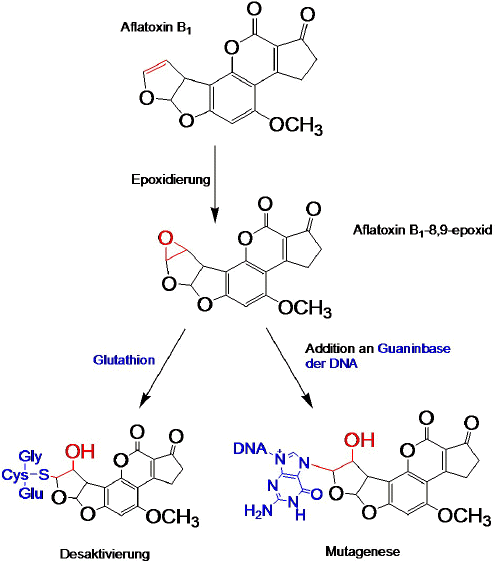
Aflatoxin was originally discovered as the cause of "Turkey X Disease" which the Dodger recalls to be a massive die off of turkeys in Europe, maybe England, arising from moldy peanuts from Africa being made into chickenfeed [well, turkey feed]. Fox News neglected to mention aflatoxin as a carcinogen. Or, as they say, a "potent" carcinogen meaning small doses causing liver tumors in animals, and considerable epidemiology in people. There's a hypothesis that high liver cancer in southeast asia and low liver cancer in US and Europe are due to afflatoxins, although there's a competing hypothesis that hepatitis is the reason.

There are a series of aflatoxin structures, which have initials. The Dodger has decided not to hold the Dodger's breath for a mention of the workers exposed to aflatoxin-contaminated materials being made into pet food.

The mold is aspergillus flavius. There's a lot of aspergillus around, notably aspergillus niger which is found sometimes on onions you buy. AF will grow on garlic as well.

Chemical methods are used for measuring aflatoxin contamination. The Dodger imagines that testing for traces of aflatoxins is complex and expensive. Human peanut butter is surveyed, the Dodger believes. Although visible inspection of materials is also employed.

The Dodger would hope some of the modern DNA technology could be applied to this potential for mold danger. Like, find the gene or genomic signature in AF which controls afflatoxin manufacture. Screen lots of other molds, starting with the rest of the aspergillus family for this signature, see if it's there, then test whether these make AF. The Dodger imagines there are strains within AF that make more of less aflatoxin.

Would any of this new information change public health behavior? Rapid and cheap methods of measuring microbial contamination might inform some practices which are now procedure based [controll of legionella in cooling towers] or organoleptic [pick the moldy peanuts out of the pile, destroy the whole pile is a sample has too many moldy peanuts.]

This may be more likely to happen because dogs got sick, than if people got sick.


[Another chemical totally fallen from view is solanine, a neuroactive alkaloid found in the green part of potato eyes.]

Sunday, January 01, 2006

Health Care Costs in the Elderly - More Blaming the Victims


Am J Prev Med 2005; 29(5):379–387

Lifestyle Risk Factors Predict Healthcare Costs in an
Aging Cohort

J. Paul Leigh, PhD, Helen B. Hubert, MPH, PhD, Patrick S. Romano, MD

Background: While the U.S. elderly population uses a disproportionate amount of healthcare resources,
there is limited knowledge from prospective studies regarding the impact of lifestyle related
factors on costs in this group. The association was examined between smoking,
drinking, exercise, body mass index (BMI), and changes in these risk factors, and
healthcare costs after 4 years among 68- to 95-year-olds.

Methods: A total of 1323 participants completed annual surveys providing information on lifestyle
factors (1986–1994) and health utilization (1994–1998). Healthcare costs in nine categories
were ascertained from validated utilization. The relationships between risk factors and
costs were examined in 2004 using linear regression models.

Results: Fewer cigarette pack-years and lower BMI were the most significant predictors of lower total costs in 1998 (p 0.001), controlling for baseline sociodemographic factors, costs, and
conditions. Associations with smoking were strongest for hospitalizations, diagnostic tests,
and physician and nursing-home visits. Those who reduced smoking by one pack per day
experienced cost savings of $1160 (p 0.05). The costs for normal weight compared to
minimally obese seniors were approximately $1548 lower, with diagnostic testing, physician
visits, and medications accounting for much of this difference. Daily walking, measured at
baseline, also predicted lower costs for hospitalizations and diagnostic testing.

Conclusions: Seniors who were leaner, smoked fewer cigarettes over a lifetime, reduced their smoking, or walked farther had significant subsequent cost savings compared to those with
less-healthy lifestyle-related habits.

>>>>>>>>>>>>>>>>>>

BrooklynDodger Comments: The main concern here another factoid to blame illness and cost on the victims, as a softening up to cut health care insurance to put the victims on the risk.

The abstract would be improved by noting that these were survey results in a cohort of university alumni, which likely makes results very class specific. The full text reveals that 29% died in the course of observation. The Dodger is unclear on whether early death was taken into account in the impact of bad behavior on total health care costs. Early death would likely save money.

The most interesting part of the paper was the analysis of cost by category:

Table 1. 1998 healthcare costs by resource category, men and women aged 68 to 95 years

Cost category......................................................Mean
Total costs, 1998 ...............................................$4732
1. Outpatient diagnostic tests......................... $1342
2. Hospital stays..................................................$1263
3. Prescription and nonprescription medications.........$943
4. Physician visits.................................................$724
5. Outpatient surgeries........................................$241
6. Emergency department visits..........................$79
7. Home healthcare visits........................................$66
8. Nursing home and rehabilitation stays..............$54
9. Nontraditional therapy visits.............................$22

>>>>>>>>>>>>>>>>>>>>>>>>>>>
The mean cost would equate to $9400 per year for an elderly couple. What does Medicare cost, and what is left over from medicare? Does this add up?

Surprising to the Dodger, outpatient diagnostic tests and physician visits way topped hospital costs. Did the hospital costs include the inpatient doctor charges? Do the prescription drug charges include the inpatient drugs? The Dodger would spin this as patients trying to stay healthy and live longer, but others might say this was evidence for voluntary behavior contributing to costs.

Drinks per week had no effect on costs. Excercise had no effect on costs although miles walked did [confounding with healthier at baseline.]